Telecom Equipment Company in Lagos
A telecom equipment company in Lagos supplies the hardware businesses and organizations use to build, connect, manage and maintain communication networks. That can include business phone systems, IP phones, PBX equipment, routers, switches, wireless equipment, fiber optic equipment, gateways and collaboration hardware.
The important distinction is that telecom equipment is not one product category. A small office replacing its telephone system may need an IP PBX, IP phones and PoE switching, while an ISP, campus or multi-branch organization may need fiber, optical modules, routers, wireless backhaul and other infrastructure.
If you are comparing companies rather than looking for one particular product, it is useful to first understand what a telecom equipment supplier actually provides and how the equipment fits together.
This guide takes a practical approach: it explains the main equipment categories, how to determine what you need, the brands buyers may encounter in Nigeria, what equipment can cost, what to ask a company before ordering and how to avoid expensive compatibility mistakes.
TL;DR
- Telecom equipment covers much more than office phones. It can include PBX systems, IP phones, gateways, routers, switches, wireless equipment, fiber and optical hardware, radio equipment, power systems and collaboration equipment.
- The right company should be able to match equipment to the application, existing infrastructure, capacity requirements, compatibility and future expansion rather than simply quote the cheapest model.
- For a business phone deployment, check extensions, concurrent calls, existing analog/GSM/E1/PRI lines, SIP requirements, network capacity and PoE before buying equipment.
- For networking and fiber projects, check port count, uplink speed, PoE budget, fiber mode, transmission distance, optical modules, connector type and the equipment at both ends of each link.
- Telecom equipment prices in Lagos vary widely. Current examples range from tens of thousands of naira for basic devices to millions of naira for high-capacity PBX, conferencing, routing, switching and gateway equipment.
- A useful quotation should identify exact models, quantities, compatibility, delivery, warranty and any installation or configuration work included.
What Does Telecom Equipment Include?
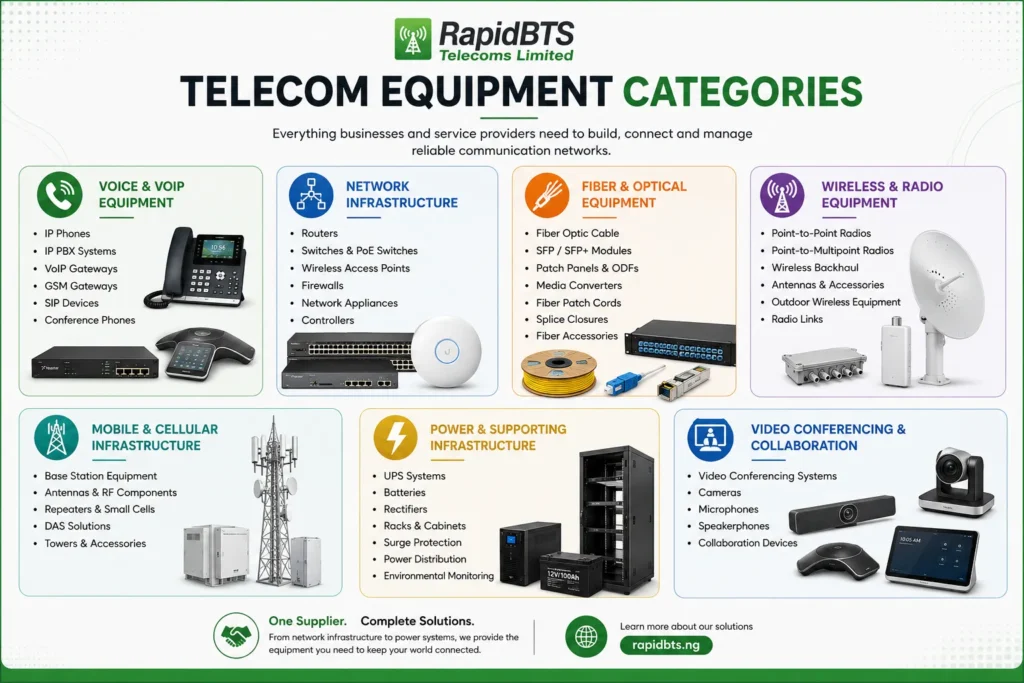
Telecom equipment is a broad term for hardware used to establish, transport, route, terminate, manage or support communications. It spans the customer-facing devices in an office and the infrastructure connecting those devices.
That breadth matters when choosing a company. A supplier that only sells desk phones may be suitable for a simple replacement, but a business building a complete communications system may also need a PBX, gateways, switching, wireless connectivity, cabling and installation.
Telecom and business voice equipment
Business telephony equipment includes IP phones, SIP phones, IP PBXs, traditional PABX systems, analog telephone adapters, VoIP gateways, GSM gateways, digital gateways, conference phones and call-centre headsets. The appropriate combination depends on how the organization receives and makes calls and whether it is moving from legacy telephony to IP.
For example, a business that wants desk-based SIP calling will usually start by matching its phones to an IP PBX or cloud phone platform. If existing telephone lines need to remain in use, a gateway may be required instead of replacing every connection.
Network infrastructure equipment
Telecom and data networks increasingly overlap. Routers connect networks and provide routing, VPN, firewall or WAN functions, while switches connect devices within the LAN. Managed switches can add VLANs, QoS, monitoring, redundancy and other controls.
Businesses should therefore treat network switches and routers as part of the communications design when deploying IP phones, video systems, wireless access points or other network-dependent equipment.
Wireless access points, controllers, firewalls and other network appliances may also be required depending on the size and security requirements of the deployment.
Fiber and optical equipment
Fiber infrastructure includes the physical cable plus the equipment that connects, terminates and converts optical signals. Depending on the project, this can include fiber distribution hardware, patch cords, splice components, media converters, optical transceivers and fiber-capable switches.
A building-to-building connection, for example, may require fiber optic cable, compatible optical modules and switches with the correct SFP or SFP+ interfaces.
For a deeper explanation of the components involved, the guide to fiber optic equipment covers the relationship between cable, optics and endpoint hardware.
Wireless and radio equipment
Wireless telecom equipment can include indoor access points, outdoor point-to-point links, point-to-multipoint radios, antennas and wireless backhaul systems. These are useful where physical cabling is difficult, a remote location needs connectivity or two sites need a dedicated wireless link.
The correct equipment depends on distance, line of sight, required throughput, frequency band, interference environment and mounting conditions. For ordinary office Wi-Fi, wireless access points are a different class of solution from outdoor wireless backhaul radios.
Mobile and cellular infrastructure
At the broader telecom-industry level, equipment can also include cellular antennas, small cells, repeaters, distributed antenna systems, RF components and base-station infrastructure. These are normally associated with telecom operators, private cellular deployments or specialized infrastructure projects rather than ordinary office installations.
This distinction is useful because a search for a telecom equipment company can cover both business communications and much larger carrier or infrastructure requirements. Buyers should confirm that a supplier has the technical scope and project experience required for the specific deployment.
Transmission, backhaul and supporting infrastructure
Larger deployments can involve optical transport equipment, microwave radio systems, multiplexing equipment, racks, cabinets, power distribution, UPS systems, batteries, rectifiers, surge protection, environmental monitoring and other supporting infrastructure.
These components become especially important when the requirement is a network build rather than a simple equipment replacement. Our guide to telecom infrastructure explains how equipment fits into a wider telecom deployment.
Video conferencing and collaboration equipment
Modern business communications also extend beyond voice. Conference room systems, cameras, microphones, speakers, wireless presentation devices and collaboration endpoints are telecom-related equipment from a business communications perspective.
For organizations equipping meeting rooms, video conferencing equipment can be specified alongside the network and communications infrastructure rather than treated as an unrelated purchase.
Which Telecom Equipment Do You Actually Need?
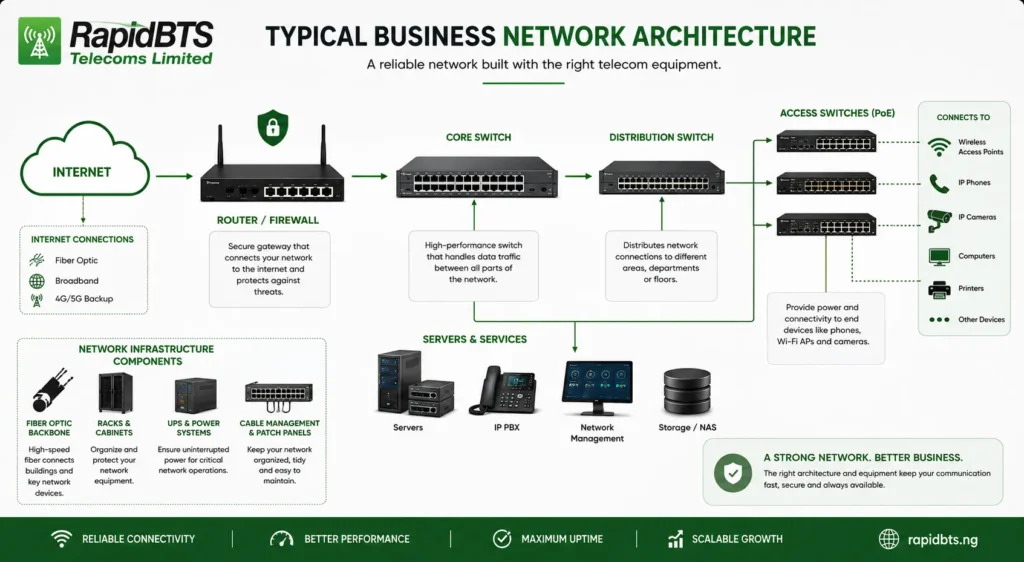
The right equipment depends on the problem you are solving. Starting with a product category and working backwards can lead to incompatible or oversized equipment. Start with the users, locations, connections and traffic requirements, then choose hardware.
For a new business office
A typical office communications deployment may include an internet connection, router or firewall, Ethernet switches, PoE where required, wireless access points, IP phones and an IP PBX or hosted phone platform. The exact combination depends on the number of users, the office layout and whether the business already has a suitable network.
If voice and data share the same network, the switching and routing design matters. VLANs, QoS, PoE capacity and network redundancy can affect voice quality and reliability, so the phone system should not be designed independently of the LAN.
For a multi-branch business
A company with several offices may need routers or SD-WAN-capable equipment, VPN connectivity, consistent IP telephony, centralized management and reliable WAN links. Fiber or dedicated wireless links may connect locations where suitable services are available.
The equipment should be sized for the traffic between sites, not merely the number of employees. A branch with 20 users and heavy cloud, voice and video traffic can require more capable networking than a larger office doing mostly local work.
For an ISP or network operator
ISP and network-operator projects can involve fiber distribution, optical modules, aggregation switches, routers, GPON equipment, wireless backhaul, power systems, monitoring and physical infrastructure. Redundancy, optical budgets, port density and expansion capacity become more important as the network grows.
This is also where a buyer should distinguish between an equipment seller and a company capable of supporting a technical deployment. The larger the project, the more important documentation, compatibility checks and implementation experience become.
For a campus or large enterprise
A campus network may use a core, distribution and access architecture, with fiber between buildings and Ethernet switching at access layers. Wireless access points, IP phones, surveillance systems and other endpoints may all depend on the same underlying network.
Capacity planning should account for uplink speeds, PoE budgets, redundant paths, available rack space and future expansion. Buying switches one port at a time without considering the architecture can create bottlenecks later.
For a call centre
A call centre places unusual demands on communications equipment because a large number of agents may be active at the same time. The design needs to account for concurrent calls, headsets, call routing, recording, network capacity, redundancy and power.
If the project includes agent workstations and telephony infrastructure, it is better to evaluate the whole call-centre setup rather than buying phones in isolation.
Telecom Equipment Brands Available in Nigeria
There is no single telecom equipment brand that is best for every deployment. Nigerian buyers can encounter different manufacturers across enterprise networking, business telephony, fiber, wireless, radio and collaboration equipment.
The following are representative examples, not an exhaustive ranking. Availability, support, model lifecycle and local stock can change, so the brand should always be evaluated against the actual project requirement.
Networking and routing brands
Common names buyers may encounter include Cisco, Huawei, Juniper, HPE Aruba, MikroTik, Ubiquiti, TP-Link, D-Link, Cambium Networks and others. They occupy different positions in the market and offer very different capabilities, management models and price points.
For example, an unmanaged switch for a small office is solving a completely different problem from a high-capacity enterprise aggregation switch. Comparing brands without comparing the models and specifications is therefore not very useful.
Voice and unified communications brands
In business telephony, buyers may encounter Yealink, Grandstream, Fanvil, Yeastar, Cisco, Avaya, Poly, Dinstar, Panasonic and other manufacturers. Some specialize heavily in endpoints, some in PBX and gateway systems, and others cover a wider communications stack.
Compatibility is particularly important here. A phone being SIP-compatible does not mean every feature will work identically with every PBX. Provisioning, codecs, BLF, firmware support, security and feature interoperability should be checked before standardizing on a platform.
Fiber and optical brands
Fiber projects can involve manufacturers such as Corning, CommScope, Prysmian, Nexans, Huawei, ZTE and other cable or optical-equipment manufacturers. The appropriate manufacturer depends on the type of cable, optical architecture, environmental requirements and project standards.
For a fiber purchase, brand reputation alone is not enough. Fiber mode, core count, attenuation, construction, connector type and optical budget still have to match the installation.
Wireless and radio brands
Wireless infrastructure buyers may encounter Ubiquiti, Cambium Networks, MikroTik, Mimosa and other manufacturers. Indoor access points, outdoor broadband radios and point-to-point backhaul systems should not be compared solely by advertised wireless speed because range, spectrum, antenna configuration, interference and environmental conditions can materially affect performance.
Video collaboration brands
Conference and collaboration equipment is available from manufacturers such as Cisco, Poly, Logitech, Yealink, AVer and others. Room size, camera coverage, microphone pickup, platform compatibility and integration with existing meeting software are more useful buying criteria than brand recognition alone.
How to Choose a Telecom Equipment Company in Lagos
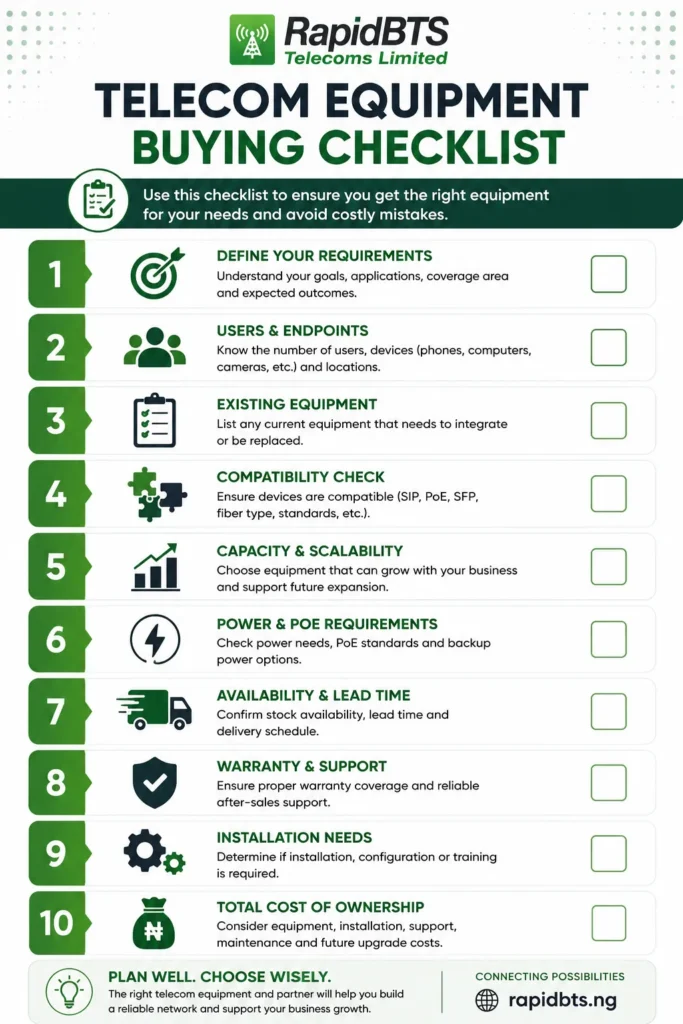
A good telecom equipment company should be able to work backwards from your requirement to an appropriate equipment list. The following checks are more meaningful than judging a supplier by how large its catalogue looks.
Can the company size the system correctly?
For a PBX, ask about users, extensions and concurrent calls rather than giving only the number of employees. For a network, discuss ports, throughput, uplinks, PoE and expected traffic. For fiber, provide distance, fiber mode, speed and the equipment at each endpoint.
A supplier that asks these questions is doing useful technical work. A supplier that quotes a model without understanding the deployment may leave you with equipment that technically works but does not meet the project’s capacity or compatibility requirements.
Can it work with your existing infrastructure?
Many Nigerian businesses are upgrading gradually rather than replacing every component at once. Existing analog lines, GSM connections, E1/PRI circuits, legacy phones or network equipment may need to remain in service during a transition.
For example, a company migrating to IP telephony may need a VoIP gateway to bridge legacy lines and the new IP system.
The same principle applies to networking. Check switch uplinks, SFP compatibility, PoE standards, VLAN support, routing features and device interoperability before assuming a new component will integrate cleanly.
Does the company provide technical support?
Equipment supply and implementation are different services. If the project requires installation, configuration, testing or troubleshooting, confirm exactly what the supplier will handle. This matters particularly for PBX deployments, multi-site networks, fiber links and wireless infrastructure.
For businesses that want professional phone-system deployment, RapidBTS provides PABX installation covering requirements assessment, installation, configuration, network setup and testing.
Are the equipment and delivery terms clear?
Ask whether the quoted model is physically available, whether the quoted price is for the exact model and configuration required, and when the equipment can be delivered. For a project with a fixed installation date, lead time can matter as much as unit price.
Also confirm warranty terms, return conditions, whether accessories are included and whether installation is priced separately. These details prevent a quotation that looks cheap from becoming expensive after the order.
How Much Does Telecom Equipment Cost in Lagos?

There is no useful single price for telecom equipment because the category covers devices with completely different capacities and functions. Prices also move with exchange rates, stock levels, manufacturer pricing and import costs.
Current Nigerian listings illustrate the range. For example, RapidBTS currently lists entry-level IP phones from roughly ₦61,000, while higher-feature business phones can exceed ₦200,000. Its IP PBX range includes models around ₦286,000 to more than ₦1.8 million, with much larger systems and capacities costing more.
Network equipment spans an even wider range. Current listings include small PoE switches around ₦63,000, while higher-capacity managed PoE and aggregation switches can exceed ₦1 million. Router pricing similarly depends heavily on throughput, interfaces and features.
Video conferencing hardware can run from roughly ₦1.15 million to more than ₦8 million for the systems currently listed by RapidBTS. VoIP gateways range from a few hundred thousand naira for lower-density devices to several million naira for high-density E1/T1 gateway systems.
These figures are examples rather than fixed market prices. A quotation should be based on the exact model, specification, quantity and current availability.
What Determines Telecom Equipment Cost?
- Capacity: users, ports, concurrent calls, throughput or connected endpoints.
- Features: managed switching, routing, VPN, security, QoS, conferencing or advanced telephony features.
- Interfaces: Ethernet, SFP/SFP+, FXO, FXS, GSM/LTE, E1/T1/PRI and other connection types.
- PoE capacity: total power budget and per-port power requirements.
- Optical specifications: fiber mode, speed, wavelength and transmission distance.
- Brand and product tier: enterprise and carrier-grade hardware generally costs more than entry-level equipment.
- Licensing and subscriptions: some platforms have recurring software or feature costs.
- Accessories and installation: racks, power supplies, optics, cabling, mounting, configuration and testing can materially change the project total.
- Availability and exchange rates: imported telecom equipment can move in price as replacement costs change.
What Should You Tell a Telecom Equipment Company When Requesting a Quote?
The quality of the information in your initial request affects the quality of the quotation. Instead of asking for ‘a good router’ or ‘a 20-phone PBX,’ provide enough information for the supplier to understand the deployment.
- Number of users, extensions or endpoints.
- Number of simultaneous calls expected at peak periods.
- Number of branches or locations.
- Existing PBX, routers, switches or other equipment.
- Existing analog, GSM, PSTN or E1/PRI lines that must remain connected.
- Internet bandwidth and type of WAN connection.
- Required network speed and number of ports.
- Fiber route distance, fiber mode and installation environment where applicable.
- Whether PoE is required and what devices will be powered.
- Required features such as IVR, call recording, queues, VPN, VLANs or centralized management.
- Whether installation, configuration, splicing or testing is required.
- Desired delivery date and project location.
A useful request might read: ‘We have 35 users across one Lagos office. We need 35 IP phones, an IP PBX, 10 simultaneous external calls, two existing analog lines, call recording and IVR. The existing LAN has 48 ports but no PoE. Please recommend the PBX, phones and PoE switching, including installation and configuration.’ That gives a supplier something concrete to design around.
Telecom Equipment Available From RapidBTS
RapidBTS is a Lagos-based telecom and business communications company that sells equipment for voice, networking, fiber, wireless and collaboration deployments. Its online catalogue covers multiple categories that can form part of the same project.
For business telephony, RapidBTS sells IP phones and IP PBX systems for organizations moving to IP-based communications.
Where legacy lines or non-IP interfaces need to be integrated, the company sells VoIP gateways covering analog, GSM/LTE and digital gateway requirements.
For the network supporting communications, RapidBTS sells PoE switches and other switching equipment, allowing IP endpoints such as phones and access points to receive data and power over Ethernet where supported.
For wireless connectivity, the catalogue includes wireless access points for business and infrastructure deployments.
For fiber deployments, buyers can source fiber optic equipment as well as SFP modules and compatible networking hardware.
RapidBTS also sells video conferencing equipment and provides business communication installation and support. The company is based in Ikeja, Lagos, and serves customers across Nigeria.
Frequently Asked Questions
What is a telecom equipment company?
A telecom equipment company supplies hardware used to establish, connect, route, manage or support communication networks. Depending on its specialization, it may supply business phone systems, IP phones, PBX equipment, VoIP gateways, routers, switches, wireless equipment, fiber and optical hardware, radio equipment, power systems or collaboration devices.
What is the difference between a telecom equipment company and a network equipment company?
The terms overlap, but telecom equipment is broader. Network equipment normally refers to devices such as routers, switches, access points and firewalls, while telecom equipment can also include PBX systems, IP phones, gateways, fiber infrastructure, optical equipment, radio systems and other communications hardware. A company may operate across both areas.
Can one company supply equipment for an entire telecom project?
Yes, depending on the company’s product range and technical capabilities. A business communications project, for example, may require an IP PBX, phones, PoE switches, gateways, wireless equipment and conferencing devices. For larger carrier or infrastructure projects, specialist suppliers may still be required for specific equipment categories.
Should all telecom equipment come from one brand?
No. A single-vendor approach can simplify management and support, but multi-vendor networks are common. The important issue is compatibility. Check protocols, interfaces, management systems, licensing, firmware support and the specific features required before mixing equipment from different manufacturers.
How do I know whether telecom equipment is compatible?
Check the technical interfaces and required standards first. For voice equipment, review SIP support, codecs, provisioning and PBX compatibility. For networking, check Ethernet speed, PoE standards, VLAN and routing requirements. For fiber, match fiber mode, wavelength, connector, optical speed and transmission distance between the cable, transceivers and endpoint equipment.
Is telecom equipment expensive in Lagos?
It can range from relatively affordable business devices to high-value enterprise and carrier equipment. Current Nigerian listings show entry-level IP phones and small switches in the tens of thousands of naira, while enterprise PBXs, high-capacity gateways, managed switches and video conferencing systems can cost hundreds of thousands or several million naira. The exact price depends on capacity, features, brand, interfaces and current market conditions.
Can a telecom equipment company install and configure the equipment?
Some companies provide installation and configuration in addition to equipment sales, but this should be confirmed as part of the quotation. For a PBX or network deployment, ask whether requirements assessment, physical installation, configuration, network setup, testing and post-installation support are included.
Does RapidBTS supply telecom equipment outside Lagos?
Yes. RapidBTS is based in Ikeja, Lagos, and sells telecom, networking and business communication equipment to customers across Nigeria. Its product catalogue includes IP phones, IP PBXs, gateways, network equipment, wireless products, fiber equipment and video conferencing systems.
Final Takeaway
The best telecom equipment company in Lagos is not necessarily the one with the longest product catalogue or the lowest quoted price. The better choice is a company that can understand the deployment, recommend compatible equipment, explain the trade-offs and provide the level of installation or technical support the project requires.
Start with the communication or network requirement, then work backwards to the equipment. That approach reduces compatibility problems, avoids paying for unnecessary capacity and makes supplier quotations much easier to compare.
For businesses looking for a supplier that combines telecom and networking equipment with business communication solutions, RapidBTS’s network equipment and communications categories can be reviewed alongside its phone-system offerings.